Title: Sketching for Creatives – Build Ideas with Pencil and Paper
Sketching isn’t just drawing. It’s thinking visually. It’s planning, experimenting, and feeling your way into a creative idea. Whether you dream of digital painting, comics, design, or just want to relax – sketching sharpens your skills and imagination.
Here’s a deeper guide to getting started:
1. Get comfortable with imperfection.
Sketching is not about making perfect art. It’s raw, quick, and sometimes messy. That’s its charm. Don’t erase every line – learn to embrace construction lines and looseness.
2. Choose the right tools.
A basic HB or 2B pencil and a sketchbook with decent paper are enough. Add a kneaded eraser and a fineliner later, but don’t overthink your materials.
3. Warm-up before you draw.
Like musicians, artists benefit from warm-ups. Fill a page with circles, lines, or shapes. This gets your hand used to motion and builds control.
4. Master gesture drawing.
Gesture sketches capture movement and flow in under 30 seconds. They train you to see the action, not the detail. Use real-life people, photos, or animals as references.
5. Study form and perspective.
Learn to break down complex objects into simple 3D shapes: cubes, spheres, cones. This will help you draw from imagination later on. Perspective (1-point, 2-point) is a game-changer for environments and depth.
6. Build a daily habit.
Even 10 minutes a day makes a huge difference. Draw your coffee mug. Sketch people on the train. Keep it light and enjoyable. Improvement comes through consistency, not pressure.
7. Capture ideas on the go.
Your sketchbook is also your idea vault. Jot down concepts, weird creatures, sword hilts, fantasy armor – whatever pops into your head. No censorship, no perfectionism.
🎯 Pro Tip: Share your sketches on net-twin.de – feedback from fellow creatives can give you new eyes for your own work.
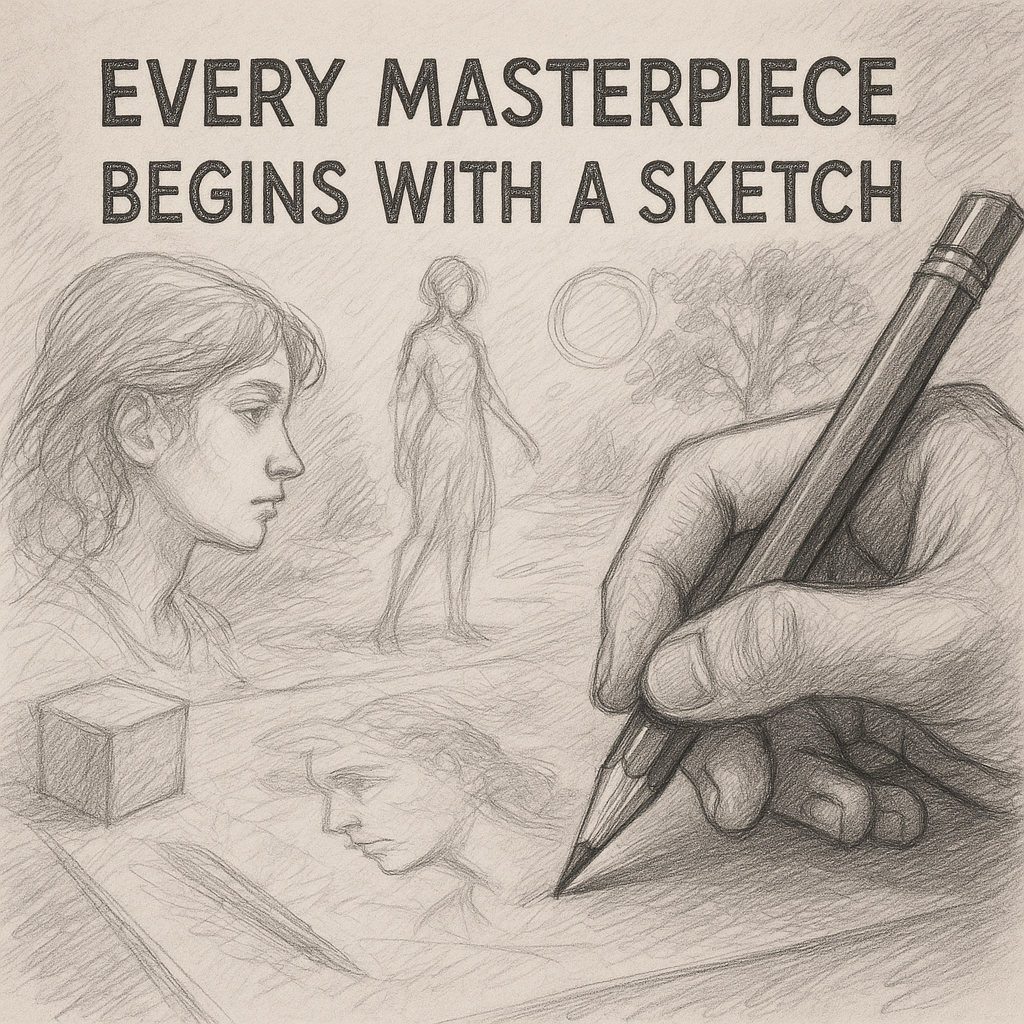
And don’t forget: Every epic artwork once looked like a weird little doodle!
Kind regards, Andy 🤩
Title: Sketching for Creatives – Build Ideas with Pencil and Paper
Sketching isn’t just drawing. It’s thinking visually. It’s planning, experimenting, and feeling your way into a creative idea. Whether you dream of digital painting, comics, design, or just want to relax – sketching sharpens your skills and imagination.
Here’s a deeper guide to getting started:
1. Get comfortable with imperfection.
Sketching is not about making perfect art. It’s raw, quick, and sometimes messy. That’s its charm. Don’t erase every line – learn to embrace construction lines and looseness.
2. Choose the right tools.
A basic HB or 2B pencil and a sketchbook with decent paper are enough. Add a kneaded eraser and a fineliner later, but don’t overthink your materials.
3. Warm-up before you draw.
Like musicians, artists benefit from warm-ups. Fill a page with circles, lines, or shapes. This gets your hand used to motion and builds control.
4. Master gesture drawing.
Gesture sketches capture movement and flow in under 30 seconds. They train you to see the action, not the detail. Use real-life people, photos, or animals as references.
5. Study form and perspective.
Learn to break down complex objects into simple 3D shapes: cubes, spheres, cones. This will help you draw from imagination later on. Perspective (1-point, 2-point) is a game-changer for environments and depth.
6. Build a daily habit.
Even 10 minutes a day makes a huge difference. Draw your coffee mug. Sketch people on the train. Keep it light and enjoyable. Improvement comes through consistency, not pressure.
7. Capture ideas on the go.
Your sketchbook is also your idea vault. Jot down concepts, weird creatures, sword hilts, fantasy armor – whatever pops into your head. No censorship, no perfectionism.
🎯 Pro Tip: Share your sketches on net-twin.de – feedback from fellow creatives can give you new eyes for your own work.
And don’t forget: Every epic artwork once looked like a weird little doodle!
Kind regards, Andy 🤩








 French
 Spanish
 Deutsch