


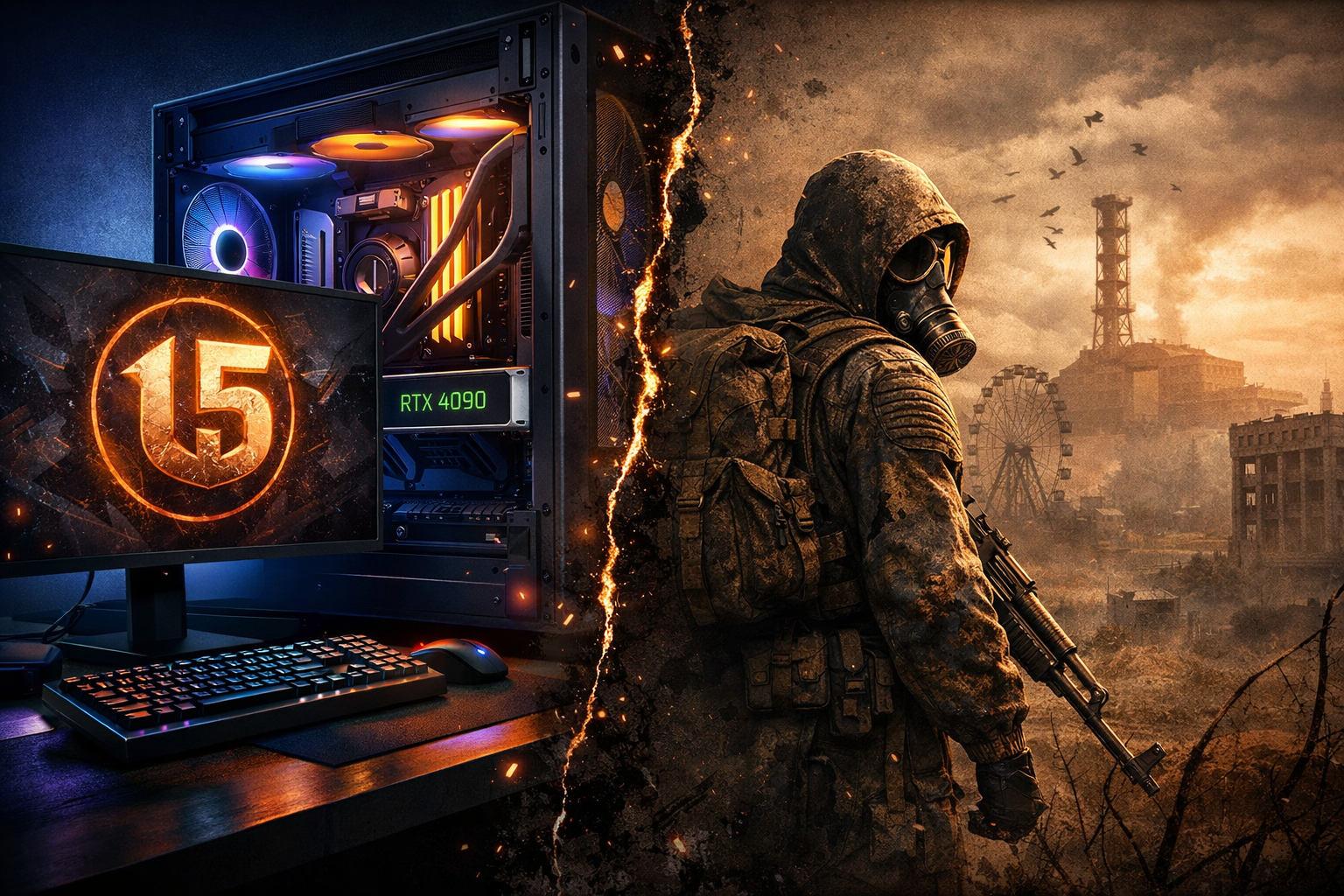
When Technology Becomes a Barrier...
What STALKER 2 and Unreal Engine 5 Tell Us About the Modern PC Market
For many players, STALKER 2 is not just another shooter. It is a cult franchise with a loyal global fanbase built over many years – often on modest PCs, not on cutting-edge hardware. That is exactly why the technical direction of STALKER 2 deserves a closer, more critical look.
This article is not about attacking the developers. It is about asking an uncomfortable but necessary question:
Did the choice of #UnrealEngine5 limit the commercial potential of #STALKER2 instead of expanding it?
---
Accessibility Beats Spectacle
There is an old rule in game development that still applies today:
A game sells because people can play it – not because it looks impressive in trailers.
Unreal Engine 5 delivers advanced technology such as #Nanite, #Lumen and large-scale worlds with minimal manual level-of-detail work. From a technical standpoint, this is impressive. From an economic standpoint, it comes at a price – and that price is high #HardwareRequirements.
STALKER 2 now primarily targets:
- Mid-range to high-end PC systems
- Modern GPUs with large amounts of #VRAM
- Players willing to upgrade hardware or spend time optimizing settings
This immediately excludes a significant part of the franchise’s traditional audience.
---
Who Is the STALKER Audience?
Historically, STALKER players are:
- PC gamers using older or mid-range systems
- Players from Eastern Europe, South America and Asia
- Atmosphere-focused gamers, not benchmark hunters
- Long-term players and modders, not frequent hardware upgraders
This audience values #Atmosphere, tension and world design far more than cutting-edge rendering features.
By raising the technical entry barrier, STALKER 2 effectively tells many long-time fans:
Come back when you have better hardware.
From a business perspective, this is a risky message.
---
Unreal Engine 4: A Missed Opportunity?
Late-generation #UnrealEngine4 (versions 4.26–4.27) was:
- Extremely stable
- Well understood by developers
- Highly optimized for mid-range PCs
- Proven in large commercial projects
With UE4, the developers could have delivered:
- Strong visual fidelity
- Dense and immersive environments
- Better performance scaling
- Significantly improved #1080p performance on average systems
Most importantly, UE4 would have lowered the entry barrier considerably.
STALKER has never relied on pure visual spectacle. It relies on mood, world-building and tension.
---
The Economic Impact: Potential Lost Revenue
Let us look at realistic, conservative estimates.
Assumptions:
- Potential interested audience: approx. 3–4 million players
- Hardware-limited exclusion due to UE5 requirements: 30–40 percent
This means roughly 1 to 1.5 million players may delay their purchase or skip the game entirely.
At an average price of 60 USD:
- 1 million lost sales equals approx. 60 million USD
- 1.5 million lost sales equals approx. 90 million USD
Even if these numbers are only partially accurate, the financial impact is significant.
Compared to this, the marketing value of using the latest engine technology appears questionable.
---
Other Games Took a Different Path – And Succeeded
Several highly successful games deliberately avoided extreme hardware demands:
- #EldenRing focused on art direction and gameplay rather than technical excess
- #Valheim proved that atmosphere matters more than polygon count
- #TheWitcher3 targeted wide hardware compatibility and achieved massive sales
None of these games needed bleeding-edge engines to succeed.
They needed reach.
---
Consoles Are Not a Safety Net
A common argument in favor of UE5 is console support.
In reality:
- Consoles use fixed performance presets
- Optimization complexity is hidden from the user
- The fragmented PC market remains the real challenge
On PC, performance problems are immediately visible and widely discussed. Negative impressions spread quickly and persist.
---
An Old Rule Still Applies
There is a saying in traditional development circles:
It is better to impress 90 percent of players than to overwhelm 10 percent.
STALKER 2 risks doing the opposite.
---
Final Thoughts
This article is not a condemnation, but a reflection.
Choosing Unreal Engine 5 was a bold technical decision, but likely not the smartest commercial one.
For a franchise built on atmosphere, immersion and long-term community loyalty, accessibility should have been the priority.
Lower hardware requirements do not weaken a game.
They strengthen its reach.
And in the end, reach is what keeps studios alive.
Kind regards, Andreas from Net-Twin 🤩
#PCGaming #GameDevelopment #UnrealEngine #HardwareBarrier #GamingIndustry #PerformanceMatters
What STALKER 2 and Unreal Engine 5 Tell Us About the Modern PC Market
For many players, STALKER 2 is not just another shooter. It is a cult franchise with a loyal global fanbase built over many years – often on modest PCs, not on cutting-edge hardware. That is exactly why the technical direction of STALKER 2 deserves a closer, more critical look.
This article is not about attacking the developers. It is about asking an uncomfortable but necessary question:
Did the choice of #UnrealEngine5 limit the commercial potential of #STALKER2 instead of expanding it?
---
Accessibility Beats Spectacle
There is an old rule in game development that still applies today:
A game sells because people can play it – not because it looks impressive in trailers.
Unreal Engine 5 delivers advanced technology such as #Nanite, #Lumen and large-scale worlds with minimal manual level-of-detail work. From a technical standpoint, this is impressive. From an economic standpoint, it comes at a price – and that price is high #HardwareRequirements.
STALKER 2 now primarily targets:
- Mid-range to high-end PC systems
- Modern GPUs with large amounts of #VRAM
- Players willing to upgrade hardware or spend time optimizing settings
This immediately excludes a significant part of the franchise’s traditional audience.
---
Who Is the STALKER Audience?
Historically, STALKER players are:
- PC gamers using older or mid-range systems
- Players from Eastern Europe, South America and Asia
- Atmosphere-focused gamers, not benchmark hunters
- Long-term players and modders, not frequent hardware upgraders
This audience values #Atmosphere, tension and world design far more than cutting-edge rendering features.
By raising the technical entry barrier, STALKER 2 effectively tells many long-time fans:
Come back when you have better hardware.
From a business perspective, this is a risky message.
---
Unreal Engine 4: A Missed Opportunity?
Late-generation #UnrealEngine4 (versions 4.26–4.27) was:
- Extremely stable
- Well understood by developers
- Highly optimized for mid-range PCs
- Proven in large commercial projects
With UE4, the developers could have delivered:
- Strong visual fidelity
- Dense and immersive environments
- Better performance scaling
- Significantly improved #1080p performance on average systems
Most importantly, UE4 would have lowered the entry barrier considerably.
STALKER has never relied on pure visual spectacle. It relies on mood, world-building and tension.
---
The Economic Impact: Potential Lost Revenue
Let us look at realistic, conservative estimates.
Assumptions:
- Potential interested audience: approx. 3–4 million players
- Hardware-limited exclusion due to UE5 requirements: 30–40 percent
This means roughly 1 to 1.5 million players may delay their purchase or skip the game entirely.
At an average price of 60 USD:
- 1 million lost sales equals approx. 60 million USD
- 1.5 million lost sales equals approx. 90 million USD
Even if these numbers are only partially accurate, the financial impact is significant.
Compared to this, the marketing value of using the latest engine technology appears questionable.
---
Other Games Took a Different Path – And Succeeded
Several highly successful games deliberately avoided extreme hardware demands:
- #EldenRing focused on art direction and gameplay rather than technical excess
- #Valheim proved that atmosphere matters more than polygon count
- #TheWitcher3 targeted wide hardware compatibility and achieved massive sales
None of these games needed bleeding-edge engines to succeed.
They needed reach.
---
Consoles Are Not a Safety Net
A common argument in favor of UE5 is console support.
In reality:
- Consoles use fixed performance presets
- Optimization complexity is hidden from the user
- The fragmented PC market remains the real challenge
On PC, performance problems are immediately visible and widely discussed. Negative impressions spread quickly and persist.
---
An Old Rule Still Applies
There is a saying in traditional development circles:
It is better to impress 90 percent of players than to overwhelm 10 percent.
STALKER 2 risks doing the opposite.
---
Final Thoughts
This article is not a condemnation, but a reflection.
Choosing Unreal Engine 5 was a bold technical decision, but likely not the smartest commercial one.
For a franchise built on atmosphere, immersion and long-term community loyalty, accessibility should have been the priority.
Lower hardware requirements do not weaken a game.
They strengthen its reach.
And in the end, reach is what keeps studios alive.
Kind regards, Andreas from Net-Twin 🤩
#PCGaming #GameDevelopment #UnrealEngine #HardwareBarrier #GamingIndustry #PerformanceMatters
When Technology Becomes a Barrier...
What STALKER 2 and Unreal Engine 5 Tell Us About the Modern PC Market
For many players, STALKER 2 is not just another shooter. It is a cult franchise with a loyal global fanbase built over many years – often on modest PCs, not on cutting-edge hardware. That is exactly why the technical direction of STALKER 2 deserves a closer, more critical look.
This article is not about attacking the developers. It is about asking an uncomfortable but necessary question:
Did the choice of #UnrealEngine5 limit the commercial potential of #STALKER2 instead of expanding it?
---
Accessibility Beats Spectacle
There is an old rule in game development that still applies today:
A game sells because people can play it – not because it looks impressive in trailers.
Unreal Engine 5 delivers advanced technology such as #Nanite, #Lumen and large-scale worlds with minimal manual level-of-detail work. From a technical standpoint, this is impressive. From an economic standpoint, it comes at a price – and that price is high #HardwareRequirements.
STALKER 2 now primarily targets:
- Mid-range to high-end PC systems
- Modern GPUs with large amounts of #VRAM
- Players willing to upgrade hardware or spend time optimizing settings
This immediately excludes a significant part of the franchise’s traditional audience.
---
Who Is the STALKER Audience?
Historically, STALKER players are:
- PC gamers using older or mid-range systems
- Players from Eastern Europe, South America and Asia
- Atmosphere-focused gamers, not benchmark hunters
- Long-term players and modders, not frequent hardware upgraders
This audience values #Atmosphere, tension and world design far more than cutting-edge rendering features.
By raising the technical entry barrier, STALKER 2 effectively tells many long-time fans:
Come back when you have better hardware.
From a business perspective, this is a risky message.
---
Unreal Engine 4: A Missed Opportunity?
Late-generation #UnrealEngine4 (versions 4.26–4.27) was:
- Extremely stable
- Well understood by developers
- Highly optimized for mid-range PCs
- Proven in large commercial projects
With UE4, the developers could have delivered:
- Strong visual fidelity
- Dense and immersive environments
- Better performance scaling
- Significantly improved #1080p performance on average systems
Most importantly, UE4 would have lowered the entry barrier considerably.
STALKER has never relied on pure visual spectacle. It relies on mood, world-building and tension.
---
The Economic Impact: Potential Lost Revenue
Let us look at realistic, conservative estimates.
Assumptions:
- Potential interested audience: approx. 3–4 million players
- Hardware-limited exclusion due to UE5 requirements: 30–40 percent
This means roughly 1 to 1.5 million players may delay their purchase or skip the game entirely.
At an average price of 60 USD:
- 1 million lost sales equals approx. 60 million USD
- 1.5 million lost sales equals approx. 90 million USD
Even if these numbers are only partially accurate, the financial impact is significant.
Compared to this, the marketing value of using the latest engine technology appears questionable.
---
Other Games Took a Different Path – And Succeeded
Several highly successful games deliberately avoided extreme hardware demands:
- #EldenRing focused on art direction and gameplay rather than technical excess
- #Valheim proved that atmosphere matters more than polygon count
- #TheWitcher3 targeted wide hardware compatibility and achieved massive sales
None of these games needed bleeding-edge engines to succeed.
They needed reach.
---
Consoles Are Not a Safety Net
A common argument in favor of UE5 is console support.
In reality:
- Consoles use fixed performance presets
- Optimization complexity is hidden from the user
- The fragmented PC market remains the real challenge
On PC, performance problems are immediately visible and widely discussed. Negative impressions spread quickly and persist.
---
An Old Rule Still Applies
There is a saying in traditional development circles:
It is better to impress 90 percent of players than to overwhelm 10 percent.
STALKER 2 risks doing the opposite.
---
Final Thoughts
This article is not a condemnation, but a reflection.
Choosing Unreal Engine 5 was a bold technical decision, but likely not the smartest commercial one.
For a franchise built on atmosphere, immersion and long-term community loyalty, accessibility should have been the priority.
Lower hardware requirements do not weaken a game.
They strengthen its reach.
And in the end, reach is what keeps studios alive.
Kind regards, Andreas from Net-Twin 🤩
#PCGaming #GameDevelopment #UnrealEngine #HardwareBarrier #GamingIndustry #PerformanceMatters


 French
 Spanish
 Deutsch